
What Is an Ultrasound Otoscope?
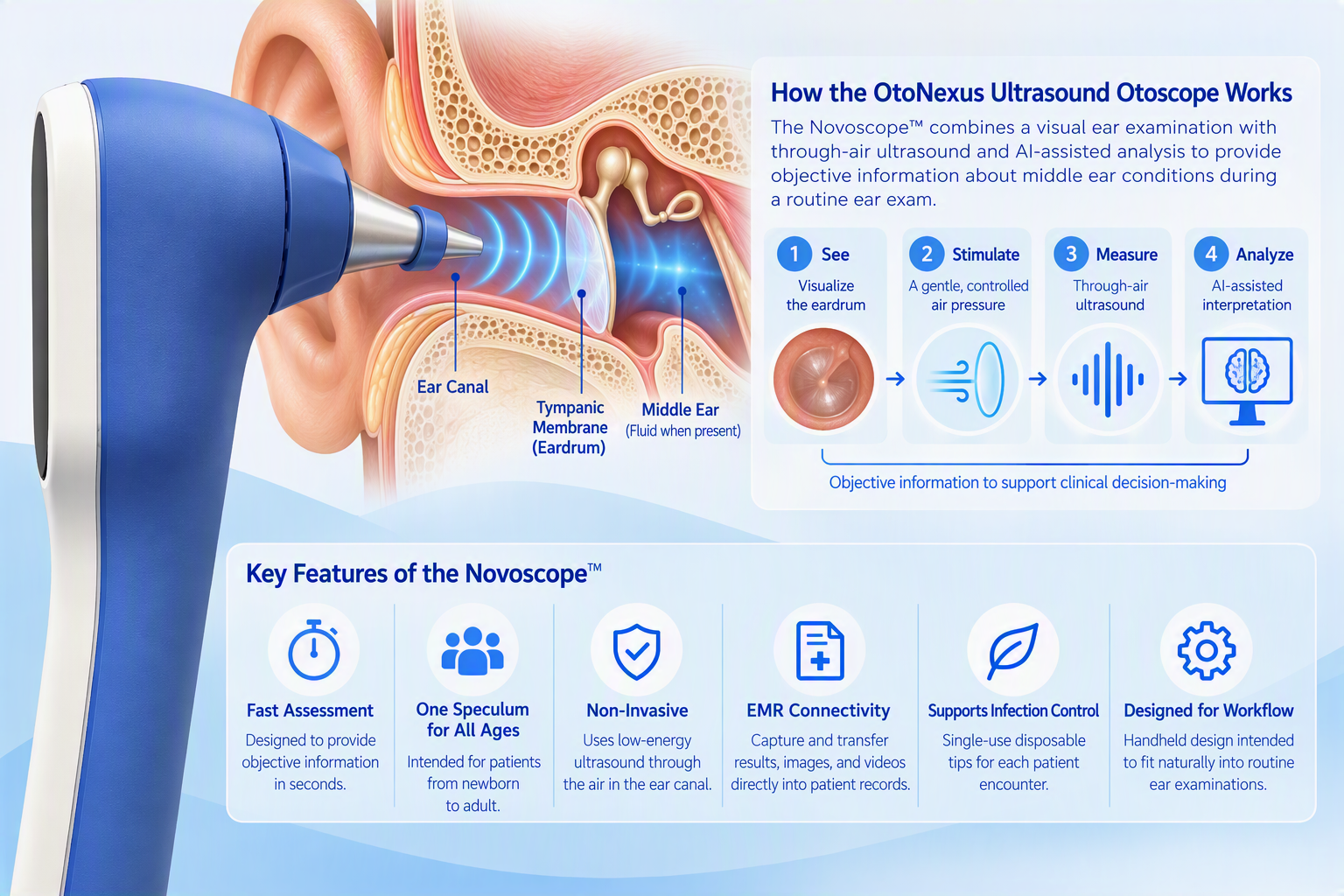
An ultrasound otoscope combines a visual ear examination with ultrasound-based measurements to provide additional information about the eardrum and middle ear. OtoNexus is developing the Novoscope™, an investigational handheld device that uses through-air ultrasound and AI-assisted analysis to provide objective information regarding the presence and type of effusion in the middle ear space to help clinicians guide treatment.
For more than a century, the otoscope has given clinicians an important view into the ear. It illuminates and magnifies the eardrum (tympanic membrane), so clinicians can look for visual signs of disease.
But there is an inherent challenge: the middle ear lies behind the eardrum, where it cannot be directly seen during a routine otoscopic examination.
OtoNexus is developing a different approach. Rather than relying on visualization alone, the Novoscope is designed to combine the familiar ear examination with objective information obtained using sound waves transmitted through the air of the ear canal.
The idea is straightforward: see the eardrum, measure its response, analyze the resulting information, and give clinicians additional data to support their assessment.
Why Can Middle-Ear Infections Be Difficult to Diagnose?
When evaluating a child for acute otitis media (AOM), clinicians look for specific findings involving the eardrum and middle ear. The American Academy of Pediatrics diagnostic guideline emphasizes findings such as bulging of the tympanic membrane and the presence of middle-ear effusion, or fluid behind the eardrum.
The challenge is that the middle-ear space cannot be directly viewed through an intact eardrum. Clinicians must interpret the eardrum's appearance and movement together with the patient's symptoms and other clinical findings.
Those assessments can vary among examiners. In a video-based study of more than 2,800 clinicians, correct diagnoses averaged 74% among otolaryngologists, 51% among pediatricians, and 46% among general practitioners. [Pichichero ME, Poole MD. Comparison of performance by otolaryngologists, pediatricians, and general practitioners on an otoendoscopic diagnostic video examination. Int J Pediatr Otorhinolaryngol. 2005;69(3):361-366. doi:10.1016/j.ijporl.2004.10.013 ]
Pneumatic otoscopy adds information by assessing how the eardrum moves when air pressure in the ear canal changes. Tympanometry can provide additional objective information about the mechanical behavior of the eardrum and middle-ear system. Clinical guidelines recommend pneumatic otoscopy when evaluating middle-ear effusion and tympanometry when the diagnosis remains uncertain.
How Does the OtoNexus Ultrasound Otoscope Work?
Most people associate medical ultrasound with a probe placed against the body using ultrasound gel. The gel provides a coupling medium that helps transmit ultrasound between the probe and tissue.
The OtoNexus approach is different.
The Novoscope is being developed to send low-energy ultrasound signals through the air-filled ear canal toward the tympanic membrane. The reflected ultrasound signals provide measurements related to the acoustic and mechanical characteristics of the eardrum and middle-ear cavity. Those responses may vary with changes in middle-ear aeration, pressure, or fluid.
One way to understand the principle is to imagine two closed containers that look identical from the outside. One is empty, and another contains liquid. Looking at them may not reveal the difference, but sound interacting with each container can produce different responses.
The ear is much more complex, but the analogy illustrates the basic idea: sound can provide information that sight alone cannot.
From Visual Observation to Objective Measurement
This is one of the central ideas behind the OtoNexus technology.
A conventional otoscope allows a clinician to observe the appearance of the eardrum. Pneumatic otoscopy allows the clinician to observe its movement in response to changes in pressure.
The Novoscope is being designed to combine visualization with an automated pneumatic stimulus and ultrasound measurements of the resulting response.
At a high level, the process can be thought of as:
See → Stimulate → Measure → Analyze
The technology is designed to convert information from the examination into objective data that can supplement what the clinician sees.
An ultrasound otoscope is not simply a conventional otoscope with ultrasound added to it. The goal is to add quantitative information about the mechanical and acoustic response of the middle-ear system to the visual examination.
Why Does Middle-Ear Fluid Matter?
Middle-ear fluid, or effusion, plays an important role in evaluating otitis media. But the presence of fluid alone does not mean a patient has an acute bacterial infection.
Otitis media with effusion (OME), for example, is defined as fluid in the middle ear without the signs or symptoms of acute ear infection. AOM involves an acute inflammatory process and has different diagnostic criteria.
This creates an important diagnostic question: can an examination provide useful information not only about whether fluid is present, but about the condition of that fluid and the middle ear?
OtoNexus technology evaluates acoustic signatures obtained with through-air ultrasound to characterize different middle-ear states.
Where Does AI Fit?
Through-air ultrasound generates acoustic measurements that must be interpreted. OtoNexus is investigating AI-assisted analysis and signal-processing methods to identify patterns within these measurements that may be associated with different middle-ear conditions.
Conceptually, the system works like this:
Ultrasound provides the measurement.
AI-assisted analysis examines patterns in the measurement.
The clinician uses the resulting information as part of the patient evaluation.
The goal is not to replace clinical judgment. It is to provide additional objective information that could help reduce uncertainty in an examination that today depends substantially on visualization and examiner interpretation.
More Than an Ultrasound Measurement
Another important feature of the OtoNexus solution is how the technology is being incorporated into the clinical examination.
The Novoscope is being developed in the familiar form of a handheld otoscope, rather than as a separate imaging system. The design combines visual examination, camera and recording capabilities with ultrasound-based measurement.
The familiar form factor addresses an important practical consideration: new diagnostic information is most useful when clinicians can obtain it within their normal workflow.
OtoNexus has designed the Novoscope around the type of handheld examination already performed in pediatric, primary-care, and other clinical settings. The device also includes recording examination information and integration of results with electronic medical records.
What Makes the OtoNexus Approach Different?
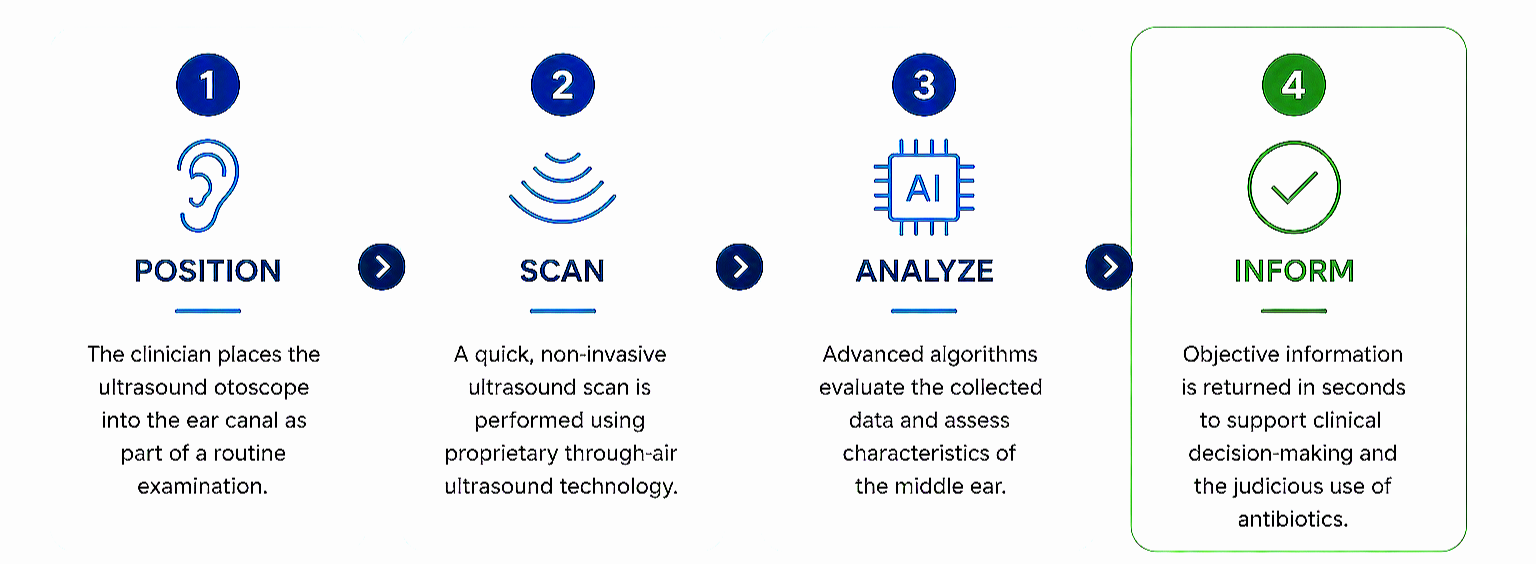
The Novoscope brings several technologies together in a single platform:
Visual otoscopy for examining the ear canal and tympanic membrane.
Through-air ultrasound that transmits low-energy sound through the air-filled ear canal.
Objective measurement of responses associated with the tympanic membrane and middle-ear system.
Automated pneumatic stimulation designed to standardize part of the examination.
AI-assisted analysis to evaluate patterns within the acoustic measurements.
A handheld otoscope-style platform designed to fit the familiar ear-examination workflow.
Why Does an Ultrasound Otoscope Matter?
Treatment decisions for middle-ear disease depend on understanding what condition is present. Antibiotics have an important role for appropriately selected children with AOM, but unnecessary antibiotic exposure can cause adverse events and contributes to antimicrobial resistance.
The potential value of an ultrasound otoscope is therefore not simply producing another image. It is providing another type of information at the point where a clinician is making a treatment decision.
OtoNexus is developing the Novoscope around that objective: combining familiar otoscopic visualization with through-air ultrasound and AI-assisted analysis to provide objective information about middle-ear conditions during the ear examination.
The Novoscope is an investigational device. It has not been cleared by the FDA and is not available for commercial sale. Its intended capabilities require appropriate clinical validation and regulatory review.
But the concept behind the technology can be summarized simply:
A traditional otoscope helps a clinician see the eardrum. The OtoNexus ultrasound otoscope is being developed to add objective information about how the eardrum and middle-ear system respond, helping clinicians see the ear exam in a new way.